

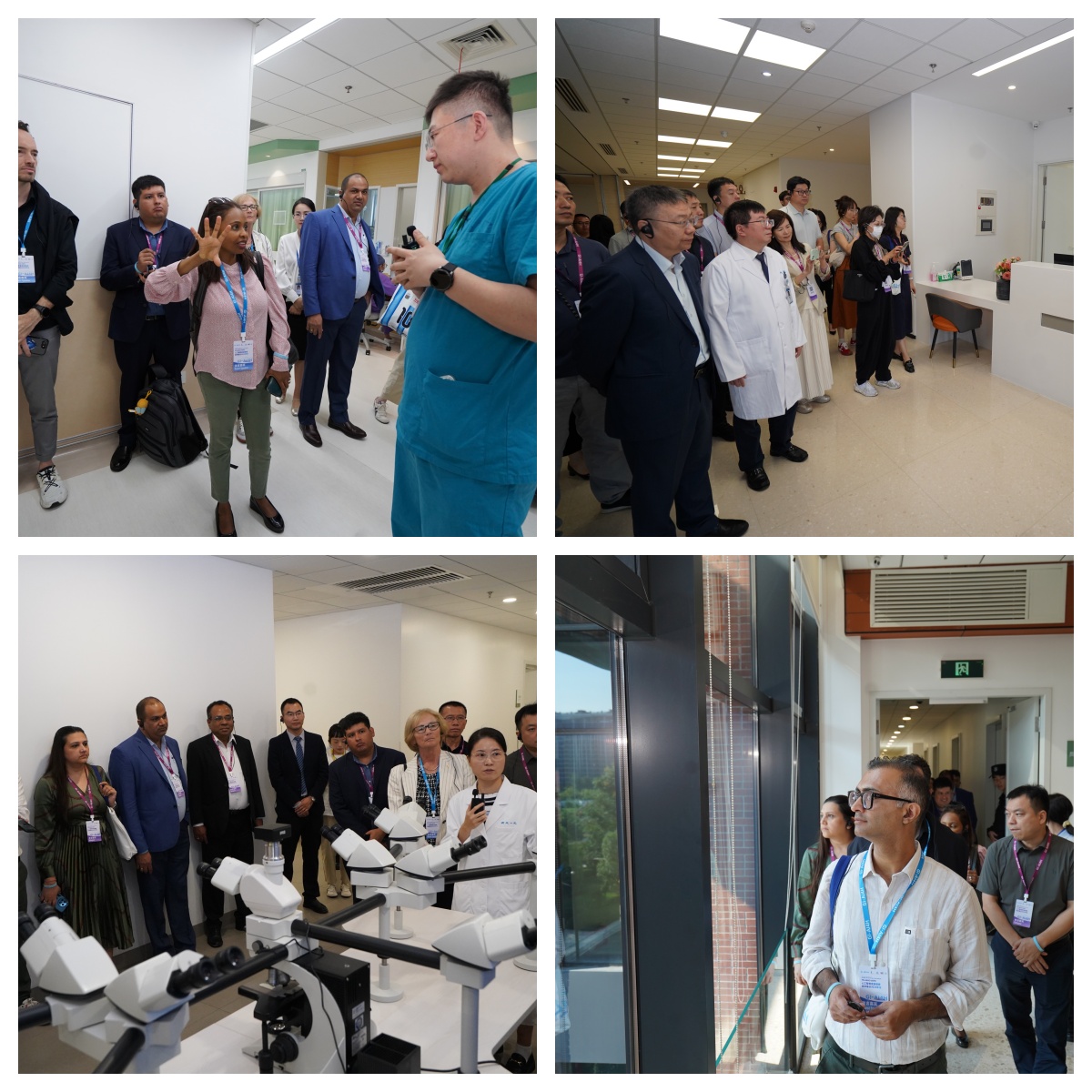
On September 16, nearly 100 international and Chinese representatives attending the 2026 Annual Meeting of the Global Initiative on AI and Health (GI-AI4H) visited the First Affiliated Hospital, Zhejiang University School of Medicine (FAHZU), exploring how artificial intelligence is being integrated into clinical care and hospital operations.
The visit brought together officials and experts from the World Health Organization (WHO), the International Telecommunication Union (ITU), the World Intellectual Property Organization (WIPO), as well as healthcare professionals and industry representatives from more than 10 countries and regions, including China, the United States, India, Brazil, Kenya and Sri Lanka.

At the outpatient area, visitors experienced FAHZU’s organ- and system-based integrated clinics, intelligent self-service facilities and multidisciplinary team (MDT) consultations. The hospital’s cloud-based smart information system enables large volumes of clinical data to be aggregated and coordinated in real time, while AI tools such as a pre-consultation agent and optical character recognition (OCR) models help streamline clinical workflows.
In the intensive care unit, the delegation learned about FAHZU’s AI-assisted critical care information and advanced support system. Built on Internet of Things technologies, the system continuously collects and integrates clinical data, creating a digital representation of individual patients to support clinicians in monitoring and managing critically ill patients.
The visit also highlighted FAHZU’s advances in digital pathology. Developed jointly by FAHZU’s Department of Pathology and Zhejiang University, OmniPT is a multimodal pathology foundation model designed to support multiple tasks, including classification, segmentation and detection. It can localize microscopic lesions within 1–3 seconds and has demonstrated accuracy above 95% across more than 10 types of cancer, including liver, gastric and thyroid cancers.
Discussions throughout the visit focused on the clinical implementation of AI, healthcare data security and patient privacy, smart hospital infrastructure, and the broader adoption of AI in healthcare.
